The
Kemenche
Sam Topalidis 2010
(Author of A Pontic Greek History)
Where music is considered a frill, where no effort
in made to transmit a musical heritage to new generations, where it is not
cultivated, music and man have been robbed of value and meaning.1
Description
The
bottle-shaped kemençe, pronounced kemenche (see Plate 1), is the beloved
instrument of Pontic people from north-eastern Asia Minor bordering the

Plate
1 Kemenche
handcrafted by Terry Topalidis,
Hellenic Club of
The
word kemenche is Persian in origin
meaning ‘little bow’. It is sometimes called
the karadeniz kemenchesi (Turkish for
The
body of the kemenche* is carved from cherry, plum,
mulberry, walnut or juniper wood with seasoned plum heart-wood regarded the
best.4 It is carved in the
shape of a trough with rounded ends and covered with a coniferous wood
sound-table. The short neck, which may
have a fingerboard, tapers to a pear-shaped pegbox. Three strings are played with a short
horsehair bow. The strings are tuned in
4ths and played in two-part polyphony (bowing across two strings at once).3 Until around 1920, some, or all of the three strings
were made of silk. However, silk strings
produce a beautiful but weak sound. Silk
made way for gut strings and subsequently replaced by metal strings.5
Two
classes of kemenche differing in size
have been distinguished, but local Black Sea Turks, did not differentiate them. The smaller ones, around 54 cm in length,
often have a fingerboard and the larger instruments are around 68 cm in
length. Also, the kemane of Cappadocia, is a type of ‘large kemenche’, which, as seen in Turkish Museums, have six strings with
a further six sympathetic strings under the fingerboards.4
In
contrast, according to the Greek kemane
player, George Poulantzaklis, the kemane
is between 55 cm and 70 cm in length and only larger in volume and
shape than the kemenche. The instruments Poulantzaklis uses have four
strings with four other strings (sympathetica) which create a vibration
(clamour) to the first four.6
The
kemenche is one of the four basic
types of lyra. The other three, the Cretan lyra (see Plate 2), the lyra of the Dodekanisa and the Thrakian lyra, are pear-shaped with three or four
metal or gut strings which are stopped from the side by the fingernails (which
differs from the kemenche where strings
are stopped by the finger tips).7 Small pellet-bells attached on the bow (which
provide rhythmic accompaniment), on the pear-shaped lyra, were once common (until around World War II), but are
now rare3 (see Plate 3).
The
pear-shaped lyra is closely related
to the medieval rebec and like the rebec, a precursor of the medieval
fiddle. The earliest known bowed instrument
and the parent of the medieval European rebec is the rabab.8
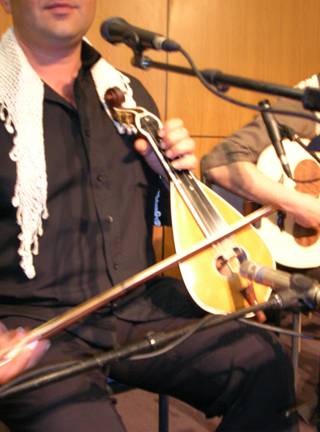
Plate 2 A Cretan lyra
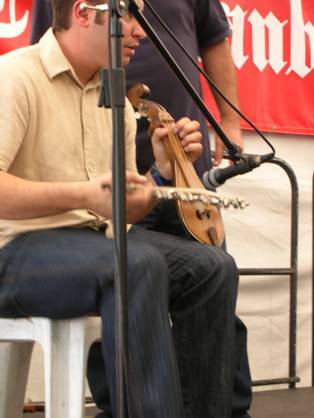
Plate 3 A pear-shaped lyra with small pellet-bells on the bow
History
The
origin and history of the kemenche are
obscure. The earliest known
representation of a kemenche appears to
be in an album of watercolours of
Matthaios
Tsahourides, researcher and respected kemenche
player, believes the instrument (which he prefers to call the Pontic lyra) and its music has similar roots
in Medieval Europe and
The kemenche was taken
to the Caucasus in the last half of the 19th century and the first quarter
of the 20th century by Pontic immigrants and refugees.9 It was also taken to
Playing
the kemenche
The
sound of the kemenche is sharp and
instantly recognisable. It is played in
three positions:
·
While sitting, with the bottom end
resting on the knee (although occasionally the fiddler will raise the fiddle above
the knee, to obtain maximum resonance).
·
While standing still, with the fiddle
hanging vertically; or
·
While actively leading a horon (chain dance), with the tailpiece
directed away from the fiddler’s body, the long axis of the kemenche being horizontal when the arms
are raised and vertical when the arms are lowered.4
In
the past, kemenche players placed their
wrist through a loop made of a ribbon, which was tied to the fiddle’s head. This helped them stabilise the instrument
when they played the notes of the upper register with the extension of the
fourth finger.2
The
string tuned to the highest pitch (on the observers right when viewed in front)
is known by Turks as the zil (I)
string and is tuned first. The sağir (II) is the middle
string and bom (III) the lowest
string. Turkish fiddlers choose a pitch
at which their instrument, often made by themselves or a local carpenter, is
most resonant.4
From
a Greek perspective, the strings of the kemenche are:
tuned on re, la, re, but their pitch is not absolute. The melody is played on the first
or the second string, either while pressing down its adjacent string so as to
form two parallel melodic lines, or touching with the bow the other string as a
drone. Kementse is mainly played solo or
accompanying the singer. Nevertheless,
when the dance takes place in the open air it may be accompanied by a second
kementse or a daouli10 [drum].
Playing
techniques of the kemenche in
The
strings of the lyra are stopped with
the player’s fingertips … using the four fingers of the left hand give
expressiveness to the colourful playing of the lyra. In order to produce
pitches higher than those of an open string, the string is firmly pressed
against the fingerboard with the fingers of the left hand, thus shortening the
sounding length, and consequently raising the pitch. The string itself vibrates only between the
bridge and the nut. … When the lyra
player plays a melody, he often simultaneously stops a neighbouring string with
the same fingers. Something similar
takes place in the case of the bow. In
the course of playing, the bow will often be used to vibrate two strings, the
string upon which the melody is played and the neighbouring string.11
In
relation to the left hand playing technique:
The
most important characteristic left-hand technique in Pontic lyra playing is the trill.
The movement of one finger produces a note that alternates repeatedly
with a sustained tone held by another finger.12
‘The
left hand playing technique is also very important in order to evaluate a
musical performance, but it is the bowing [right hand
playing] that
forms the overall acoustic result.’13
The
bow is held firmly, yet lightly, between the fingers and thumb of the right
hand. The third finger is in a position
to exert varying pressure on the bow hair. … The bow is drawn at right angles
across the strings … The correct bow position on the instrument (about 2 to 4cm
away from the bridge) makes a clear and pure sound. … In performance, the
performer may need to turn the body of the instrument with his left hand in
order for the bow to touch another string.14
Defining
a specific melody in Pontic lyra
music is very elusive. There is no
authoritative or written version of a melody or tune and each time it is
performed by the lyra player, it is
played differently. … The use of modulation in Pontic lyra music is common. The lyra player usually modulates by playing
a melodic phrase in a different key tonality above or below that of the
original tonal centre. In contemporary
music repertory, most of the time modulation takes place through
improvisation. Thus, the Pontic lyra player may modulate by improvising
and changing the mode of the original piece but must always return to the tonic
of the original tune.15
Distribution
in
It
appears that
In
Findikli (130 km east of
the
average speed [of
playing]
falls, and extended use of undecorated fourth parallels becomes more
frequent. In villages south of Pazar [100 km
east of
From
the work of Dr Davis in his volumes of Flora
of Turkey, the distribution of Turkish folk musical instruments is
regulated in part by similar factors that regulate the distribution of wild
plant-species. Barriers to the spread of
plants are usually also barriers to the movement of men.4
It may be
significant that the kemenche appears
to be linked with the hazelnut cultivating population of the eastern coastal
region.4
References
1 Kilpatrick,
DB 1980, Function and style in Pontic dance music (A dissertation
submitted
in partial satisfaction for the degree Doctor of
Philosophy
in Music 1975,
Archeion
Pontou [Archives of Pontos], supplement no.12,
Epitropi
Pontiakon Meleton [The Committee for Pontic
Studies]
2
Tsahourides, M 2007, The Pontic lyra in contemporary
PhD
thesis,
3
The
New
Grove Dictionary of Musical Instruments, In three volumes.
1985.
4
Picken,
L 1975, Folk musical instruments of
5
Anoyanakis,
F 1991, Greek popular musical instruments, Melissa Publishing
House,
6 Poulantzaklis,
G www.kemanes.gr/english/index.php?page=kem-lyra
viewed May 2010.
7
New
2001,
8
Encyclopaedia
Britannica,
2005,
9
Petrides,
Th n.d., ‘Traditional Pontic
dances accompanied by the Pontic lyra’, at: www.karalahana.com/english.html edited by Ozhan Ozturk, under the heading
Pontic Music, created 2005, viewed June 2006.
(Petrides lived 1928-88.)
10
Raftis, A 199?, Twenty Pontic dances and songs, Booklet
on Pontic Greek songs with compact disk, Dora Stratou Greek Dances Theatre,
Athens, pp. 18-9.
11
Tsahourides, M 2007, pp. 45-6.
12
Tsahourides, M 2007, p. 47.
13 Tsahourides, M 2007, p. 52.
14 Tsahourides, M 2007, p. 49.
15 Tsahourides, M 2007, p. 58.
16
Reinhardt,
K 1966, Quoted in Picken (1975).
17 Picken, L 2007, pp. 329-30.
* Kemenches
can be purchased from The Violineri. Details available from: http://kemenche.pontosworld.com
# In the future, I look
forward to reading information that is more contemporary from accomplished
kemenche player, Nikos Michailidis, who is researching for his PhD thesis.