A History of Amisos (Samsun)*
Internet
article by Sam Topalidis 2013
Pontic author
1.
Introduction
Modern Samsun (see note 1), known as Amisos by Greeks and
Byzantines, Missos by Romans, Simisso by Genoese and then Samsun by Seljuk Turks
and Ottoman Turks lies between the deltas of the Kizilirmak (ancient Halys) and
Yeşilirmak (ancient Iris) rivers (Figure 1).
It is the largest city and the main port for trade of the middle Black
Sea coast in Turkey. Amisos lies within
the region referred to by Greeks as the Pontos (note 2)—the northeast
portion of Turkey adjacent the Black Sea.
The
coastline from Amisos to Batumi in the east is hemmed in to the Black Sea by
the Pontic Alps, which rise to over 4,000 m in the east. The culture of the coastal area has always
been isolated from that of central Anatolia by the mountain range which has few
passes.5
Ancient Amisos lies 165 km east of Sinope on the flat
top and eastern slopes of a plateau headland just to the west of modern
Samsun. It didn’t have a good harbour;
nor was it near the mouth of a major river.
Historically its main assets were iron, probably traded from the
Chalybes (see section Early Human Settlement), olives (Strabo) and some silver.3 Historically, Amisos
had intensive links with central Anatolia and looked more inland than across the
Black Sea.35

Figure 1: Black Sea19
The hills come down
to the sea for a short distance on either side of Amisos and then, on the
eastern side, the coast opens up into a wide plain. It has both a fertile hinterland and a major
caravan route. Three gentle passes south
of Amisos offer the easiest route over the whole stretch of the Pontic Alps. At Amisos a large flat-topped natural
acropolis about 2.7 km long north to south and 1.5 km wide, rising to
159 m overlooks the sea. The
acropolis reaches the sea at a steep promontory and there is some shelter on
the east side.7
This article covers the settlement of indigenous people around Amisos,
Greek colonisation, the Mithradatic Wars with Rome, the Byzantine period, the
Seljuk Turks, the Ottoman Turks, its commercial rise in the late 19th century,
the impact of Mustafa Kemal and the exchange of Christian and Muslim
populations between Greece and Turkey in the 1920s.
2.
Early Human
Settlement
Northcentral and northeastern Anatolia remains devoid of
Neolithic settlement from 9600 to 7000 BC (the Anatolian pre-pottery
phase). It is unclear whether these
regions have buried Neolithic sites or experienced adverse climates or whether
they were sparsely populated by communities of hunters and gatherers. Evidence from the northeastern highlands
indicates that village societies moved into this rugged terrain as late as the
fifth millennium BC (Chalcolithic Age).27
From surveys of settlements in the central Black Sea region
(including the Samsun province), the number of settlements decreased
considerably from the third to the second millennium BC.12
There is little
evidence of settlement in the inland and coastal areas of the central Black Sea
region, even in the Middle Iron Age (850–650 BCE). The absence of population between 1200 and
650 BCE is that at the end of the Late Bronze Age the territory was
controlled and populated by the nomadic Kashka people, who were enemies of the
Hittites. Thus the region formed a
buffer zone:
from
the archaeological evidence it is clear that the Central Black Sea region was
under the dominion of Proto Indo-Europeans before the Early Bronze Age II,
beginning from around 2800 BC … By the Early Bronze Age II period, it
was under the dominion of Indo-Europeans, this time culturally linked to
Central Anatolia, and from 1700 to 650 BC it was under the Gashka [Kashka] people. After this, from 650 BC onwards, an
Indo-European people related to the Phrygians lived there.35
Settlements revealed in
Samsun’s city centre (e.g. Dundartepe) indicate they were occupied during the
Early and Middle Bronze Age.11
According to the
Greek General and historian Xenophon (ca. 400 BC) who with 10,000 Greek
mercenaries travelled through the southern Black Sea region on route back to
Greece from Persia, stated the local people closest to the Black Sea littoral
included the Macrones, Colchians and Drilae near Trabzon; the Mossynoeci west
of Cerasus (modern Giresun); to the west of them the Chalybes and to their west
the Tibareni around Cotyora (Ordu). West
of Ordu, and around Amisos lived natives, but their names were not given. Unfortunately, Xenophon did not pass through
Amisos but sailed past it to Sinope.38
Not much is known archaeologically
of the Black Sea natives mentioned by Xenophon.35 Other written historical
sources record the native people around Amisos as; Syroi (Herodotus), Assyrioi
(Ps.-Skylax), Leukosyroi (Strabo) or Kappadokes (Strabo) (Figure 2).3
3.
Greek Colonisation
There are
inconsistencies in the written historical sources about the Greek colonisation
in the Pontos and the current archaeological evidence. The Greeks knew the Black Sea as early as the
8th century BC.
This view is based on archaeological evidence and on early Greek legends
such as Jason and the Argonauts who set out to find the Golden Fleece in
Colchis (modern Georgia, see Figure 1).
Some scholars believe this legend occurred before the Trojan War because
Homer mentions the legend in the Iliad.33
The earliest Greek
trade with the lands around the Black Sea was reflected in the Greek legends
about the origin of iron. According to
these legends items of iron first came from the Trans-Caucasian regions.10 Also, according to Apollonius of Rhodes’ story of The Voyage of the Argo, the mythical
Amazons lived just east of Amisos in three towns near Themiscrya near the
mouth of the Thermodon (modern Terme) river.
The Black Sea littoral was heavily populated by local
natives and from the outset, many of these were hostile to the Greeks, e.g.
between Byzantium and Heraclea (Figure 3),
there were no Greek colonies despite the ideal locations, because the historic
sources state the region had hostile natives.34

Figure 2:
Amisos31
In the written historical sources, it is unclear exactly
when the Greeks appeared on the southern Black Sea coast. However, Greek pottery from the Halys valley
(between Sinope and Amisos, see Figure 2) proves the Greeks had contacts
there long before the foundation of the coastal cities. Iron Age settlements testify to significant
cultural exchange in the late Archaic period (Archaic period ca. 750–550 BC). Sites along the Halys basin yielding Greek
pottery and architectural terracottas seem to indicate that the Greeks paid
special attention here. The reason was
due to this valley’s abundant resources such as red pigments and other
minerals.31
The Milesians (Figure 3) drove out from Sinope the
weakened Leucosyrians [also referred to as White Syrians or Kappadocians] after
a period of occupation by the Kimmerians.
Sinope then conquered land from the natives to the east for her
colonists.3
Amisos was founded around 564 BC. Ancient authors state two interpretations: a
Milesian foundation, or a joint foundation by Phocaea and Miletos (note 3). The archaeological evidence from Amisos just
adds to the confusion. No proper
excavation of the settlement has been conducted because of modern
overbuilding. For example, the site of
the acropolis is occupied by a Turkish military base, to which there is no
access. Its construction is believed to
have destroyed many archaeological and architectural remains.35
The Greek settlers in both Sinope and Amisos had to deal
with the indigenous people from the beginning of their colonial activities,
since their survival depended on access to the native territory to obtain
agricultural products, minerals and metals.
The presence of local pottery in Amisos suggests
that the native Kappadocians formed a part of the population there. Amisos may have been founded over an already
existing settlement or it could have received people from the surrounding area.31

Figure 3: Miletos and some
of its Black Sea Colonies17
4.
The
Mithradates (302–63 BC) and Rome
Soon after Xenophon’s journey (ca. 400 BC) through
the northern part of Asia Minor, Amisos, like other Greek coastal towns of Asia
Minor, in 386 BC came under Persian control.14
Soon after this came the conquering Alexander the
Great. However, Alexander’s army did not
advance north of Ankara and so west Pontos remained under the command of
satraps of Persian origin while the isolated east Pontos had never been
conquered. (Some sources assume
Alexander liberated the Pontos.) After
the death of Alexander in 323 BC and the creation of the Hellenic
kingdoms, Mithradates I declared east Pontos independent and in
302 BC he established the kingdom of Pontos. He did not interfere with the body politic in
the Greek cities of the coast which controlled the markets and shipping. Greek was the official language of his realm.20
The origins of Mithradates I Ktistes (the builder)
(302–266 BC), the first Pontic king, is not very well understood. He probably came from the upper classes of
Pontos, and was possibly related to the Persian dynasts. Mithradates I and a succession of kings
from the same family ruled over the area from Heraclea (420 km in a
straight line over land west of Amisos) to Trabzon (290 km
in a straight line east of Amisos) for over 150 years until the reign of
Mithradates VI Eupator (120–63 BC), where the kingdom of Pontos
reached its peak (note 4).15
This
period of prosperity however, was short-lived.
Mithradates VI had ambitions beyond the Black Sea as he set his
sights on the Hellenistic world of Asia Minor which was under Roman rule. The series of Mithradatic Wars waged against
the Romans compelled Rome to send considerable forces to Pontos to quash
Mithradates.20
Mithradates VI
Eupator chose Amisos as his royal residence where he built Eupatoria, a new
quarter which was an extension to the old city.
During the third Mithradatic War (74–63 BC) the Roman General
Lucullus laid siege on Amisos. In the
summer of 71 BC Amisos was captured after the guard set fire to the city and
then escaped by sea. Against Lucullus’
wishes, the Roman pillage lasted overnight, but Amisos was saved from total
devastation by rain. Lucullus partially
restored the city, liberated it and extended its territory.14
In
63 BC, Amisos was ceded from General Pompey to Bithynia and was
incorporated in the newly established province of Bithynia-Pontos. In the winter of 48–47 BC
Pharnakes II, son of Mithradates, captured Amisos. Caesar then defeated Pharnakes in 47 BC
and set Amisos free. In 39 BC, Mark
Antony included the city in the province of Pontos Polemoniakos. The city was then ruled by tyrants. Finally, Octavian (the later Augustus) in
31 BC proclaimed Amisos free and a Roman ally.14
According
to the 2nd century AD geographer, Ptolemy, Amisos (in his day) belonged to
the province of Galatia. After the Roman
Emperor Diocletian’s monetary reforms in 286 AD it was included in the
province of Diospontos which was renamed Helenopontos by Constantine I
(324–37 AD). From the Roman period,
Amisos was known as Missos.14
5. Byzantine and Seljuk Turk Era
During
the late antiquity and throughout the Byzantine era, Amisos was a significant town. In around 860 AD it was a tourma (an
administrative division) in the theme of Armeniakon. Byzantine Emperor Constantine VII
Porphyrogennitos (913–59 AD) stated the importance of the port. Amisos played a key role in Byzantine
economy. In the second half of the 9th and
throughout the 10th century it was a kommerkion
[it applied a customs tax] and an export centre for
cereals. During this period fiscal
officials were stationed in the city.14
Having been held by the Byzantines, Amisos seemed to have passed without
a fight to the Seljuk Turks in ca. 1194,
becoming part of the lands of Rukn al-Din, an ally of Byzantine Emperor Alexios III.
In 1204, it passed equally casually to
Alexios and David Komnenos (founders of the Empire of Trebizond), despite the
recapture causing considerable disruption to the Seljuk Turks.7
What seems to have happened at Amisos was Turkmen infiltration and settlement
before 1194 and the establishment of a rival port of Samsun, side by side with
Amisos (both located in the northwest quarter, east of the acropolis, see
Figure 4). Although Samsun was
under Seljuk Turk rule during ca. 1194
to 1204, Amisos probably remained Greek and that there was a local
accommodation of interests.7
Classical Amisos, on the acropolis, was probably abandoned before 1194. Byzantine Amisos and Seljuk Samsun, were
therefore probably on the beach (northwest quarter). The site taken by the Seljuk Turks in 1214
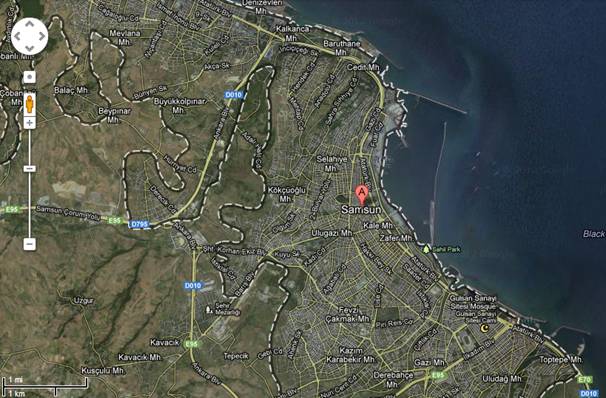
Figure 4: Modern Samsun (Google
satellite maps)
probably
also represents Byzantine Amisos. The
Genoese station of Simisso
was
established by 1285 (southeast quarter) only an ‘arrows flight away’ from
Samsun and provided protection to the local Greeks and Armenians, who were
probably still the majority of the population.7
There was a period of Greek-Turkmen coexistence, but this site became
Turkish Samsun after 1214. The town and
castle of Samsun was probably established as a Seljuk Turk settlement after the
Seljuk ‘recapture’ in 1214. In 1242, the
Mongols defeated the Seljuks and reduced them to tributary status. As a consequence, the empire of Trebizond who were
Seljuk vassals for the past decade, consequently changed masters.21 But after the Mongol withdrawal (note 5),
Samsun was ceded to the Turkmen Isfendiyaroglu dynasty of Sinope.7
6. Ottoman Turk Period
By the 14th century, Turkish Samsun and Genoese Simisso were still
distinct settlements existing side by side.
The Ottoman sultan Bayezid I captured Samsun around 1393 but the
Mongols blocked all trade through it in 1401.
By 1404 it was in the hands of Bayezid’s son (note 6). The Turkmen Isfendiyaroğullari from
Sinope retook it in 1419, but it returned to the Ottoman sultan Mehmet I
shortly afterwards. Except for the
period 1233–48, Ottoman Samsun does not seem to have been notably important
although it offered the Ottomans access to the Black Sea.7
Genoese Simisso (on the southeast quarter) was relatively important. The two places (Genoese Simisso and Turkish
Samsun) were an effective partnership of Italian capital and naval expertise
with Turkish merchandise and supply routes.
During Timur’s (Tamerlane) incursion and after the Ottoman reoccupation
of 1419, trading conditions became less profitable.7
Millet, barley, beans and chickpeas were exported from Genoese Simisso
to the territories north of the Black Sea.
From the north, Simisso received hides, edible fats and slaves.32 The Genoese colony left shortly after 1424 having
set fire to their base. After 1452 the,
now presumably single, town fell into a decline until its astonishing
resurgence in the 19th century.7
In 1701, French botanist Tournefort found a village built on the ruins
of Amisos. In 1813, Kinneir observed
that the ships from the port were navigated by Greeks; for although the
population of the town was almost entirely Turkish, the adjoining villages were
primarily populated by Christians.6
In 1806, Samsun burnt to the ground and by 1829 it was still
recovering. In 1838, Suter visited
Samsun and thought the town had a population of 450 Turkish and 150 Greek
families. In 1847, Ferrukhãn Bey also
visited Samsun and recorded it comprised 500 Turkish, 240 Greek,
60 Armenian and a few European households.32
From Kadiköy the Greeks began to take over the
commerce of the port as it slowly became more active under the Hazinedaroğlu
dynasty who ruled the area from 1806 to 1854.6 ‘As late as the
1860s there was only a small Turkish village on the shore and a smaller Greek
suburb inland at Kadiköy; their combined population did not reach 5,000’.7
In 1864 Van-Lennep observed the city of Samsun faced the northeast built
in the shape of a crescent with a promontory sheltering it on the
northwest. He also observed that Foreign
Governments found it difficult to induce any of their officers to reside in
Samsun as it was an unhealthy place due to the diseases that could be caught
there.36
7.
Rise of Commercial
Activity From 1860
From the
15th century, Samsun had been a depressed village. Its revival began with the building of the metalled
highway south to Amasya and with the expansion of the tobacco industry of
nearby Bafra. By the 1860s, Samsun
became the port of the main Constantinople-Bagdad route and was finding
international markets for its tobacco.
The most impressive feature of the revival of Samsun (as well as Bafra)
was that, with small local resources, the Greek proportion of the population
rose to 40%. But this massive rise in
the Greek population was due to immigration, especially from the west coast of
Turkey and Constantinople.5
Samsun,
unlike its surrounding villages, was not occupied mostly by Greeks, but Greeks dominated
its commercial life. Of the 214 businesses
in Samsun in 1896, no fewer than 73% were owned by Greeks and 17% by Armenians.6 In
1910, Samsun numbered around 40,000 souls, and Greeks, Armenians, or
Franks controlled no fewer than 91% of its 156 businesses and 85% of the
shares of the Bafran tobacco market. Its rapidly rising population is believed to have overtaken
that of Trabzon about 1910 (Table 1).7
Assuming the population
figures in Maccas (1919) are ‘reasonable’; by 1911, of the nearly 120,000 people
in the Samsun kaza (district), around
65% were Greek.6
Table 1 Approximate indication of the populations
of Trabzon and
Samsun, 1860 to 1925 (1,000)#
|
Year |
1860 |
1870 |
1880 |
1890 |
1900 |
1910 |
1920 |
1925 |
|
Trabzon |
34 |
35 |
36 |
38 |
38 |
38 |
33 |
24 |
|
Samsun |
4 |
7 |
9 |
11 |
17 |
40 |
33 |
20 |
# Numbers were derived from reference6
Childs who travelled to Samsun at its peak in 1913 stated the town
stretched along a beach for a couple of miles, and its suburbs went up the
slopes of foot-hills behind in a scatter of white buildings. There was no esplanade or marina facing the
sea; offices, warehouses, and cafes push their backs down the shore as far as
possible. He stated the town was
commercial in its interests and had no wish to think of amenities. It is a growing town of some 40,000 people
despite Turkish neglect. Much of the
trade and wealth of the town was in the hands of the Ottoman Greeks.8
The second great expansion of Samsun at the
turn of the century was stimulated by the building of the Samsun-Sivas railway which was begun in 1891. However, its construction, under, at various
stages, American, Belgian, French and Turkish management, was protracted. Amazingly the first train did not leave
Samsun until 1924, only reaching Sivas in 1932.6
8.
1915–17 Deportations
of Armenians and Greeks
During World War I (1914–18), the Ottoman
Turks implemented their genocide of their Anatolian Armenian Christian subjects. The Armenian deportation from Samsun began in
July 1915. Samsun’s leading Armenian
figures had previously been arrested in April.
In July, as the Armenian deportees began to march out of Samsun, the men
were separated from their families and killed about a mile from the city. German Consul at Samsun, Kuckhoff, maintained
that the Ottoman government, claiming to react to revolutionary activities by Armenians
(particularly in Van), engaged in the wholesale destruction of the Armenian nation.24
American consular
agent W. Peters at Samsun reported in August 1915 that great numbers of
Armenians had been sent inland from Samsun.
Of these, most of the men were murdered somewhere beyond Amasya, while
many women and children had been taken to Malatya and thrown into the Euphrates
river.30
Later in April 1916, after the Russian army occupied Trabzon, thousands
of Anatolian Muslims fled westwards. The
Russian occupation increased the disdain of the Ottoman authorities for their
Christian (and Orthodox Christian Greek) minority which was suspected of
working for a Russian Orthodox Christian victory.
The Ottoman authorities announced that wherever Orthodox Christians
failed to report for military service, or had deserted after joining up, their
community would be held responsible. [Conscription
meant joining the dreaded labour battalions servicing the army because from
1915, Christians were not allowed to bear arms in the Ottoman army.] This provided an excuse for the Ottomans for a
first round of village burning, and that in turn produced Christian retaliation. Many adult males from Samsun took to the
mountains and joined the guerillas (note 7).9
The German Consul at Samsun, Kuckhoff, reported in July 1916 to Berlin,
‘exile and extermination has the same meaning for the Ottoman Turks because
whoever is not murdered dies of hunger and disease.’26
In December 1916, for allegedly ‘strictly military
reasons,’ Ottoman War Minister Enver ordered the deportation of the Greek
population from the Black Sea coast to an area of 50 km. However, the German diplomats understood that
the harsh winter season and the ‘failure to organise provisions’ would lead to
high casualties.18
On 27 December 1916, Samsun was encircled by the Ottoman army and
all the population was called to the upper Samsun square (Kadiköy). All the Greeks were imprisoned. They followed their executioners on foot, all
night long, through the snow-covered mountains.
All this horrible treatment has one object, namely,
the annihilation of the Greeks in Turkey, who must disappear as have the
Armenians. Already one-fourth of the
deported population has died, and the same fate is awaiting the thirty thousand
persons who have been deported from our [Samsun] District (Sanjak).4
The German diplomats understood in early 1917, that
the ‘ban of the Greek population of Samsun,’ which had been conducted under the
pretext of pursuing Greek bands in reality, was just a ‘large scale’
persecution of Greeks.18 Between December 1916 and February 1917, the
German Consul Kuckhoff reported that in the Samsun region alone, on the pretext
of seeking 300 Greek deserters, some 88 Greek villages were torched.26
Winter combined with
the lack of transportation for those deportees, led to great misery. The Greeks living in Bafra and Samsun were
sent to the interior towards Ankara. The
Turkish medical doctor, Sağlam, reported in 1941 that health stations were
established for the deportees in Kavak (50 km southeast of Samsun), Havza
(85 km southeast of Samsun), and Merzifon (110 km southeast of
Samsun), where the surviving deportees had to ‘apparently’ undergo medical
examination. Here, those with infectious
diseases and those with lice were cleaned and ‘apparently’ all the deportees
were vaccinated.23 Whether these health stations were actually established
has not been verified by other sources written in English. It is known that deportees were pushed into hot public baths and quickly removed which only increased their
mortality during winter.2 (There are hot springs at Havza.)
In some villages, the Greek inhabitants were deported with only a few hours’
notice; in others, the men were conscripted into labour battalions, and then
the villages themselves were looted by their Muslim neighbours. The central government had no intension of
allowing the deportees to ever return home because Muslims were systematically
settled into the vacant Greek houses.
Some provinces were instructed not to allow Greeks to return and
resettle on the coast.1
In the Samsun region, in January 1917, 4,000 inhabitants were
deported, first to Havza then to Çorum. The surviving
Greek deportees were resettled in former Armenian homes of the previously deported
(genocided) Armenians. During the
Armistice in late 1918 the surviving Greeks were able to return home.
In a series of letters [in 1919] to the
Patriarchate in Istanbul, the Greek Orthodox Patriarch of Samsun, Germanos
Karavangelis, states that roughly thirty thousand people had been deported from
his area to the province of Ankara.
Villages evacuated in three or four separate waves of expulsion had been
subsequently looted and razed; additionally, the convoys of deportees had been
attacked and both women and children had been killed [note 8].1
9.
1919 Arrival
of Mustafa Kemal
The Armistice between the defeated Ottoman empire and the Allies in
World War I was signed on 30 October 1918 at Mudros harbour on the
Greek Island of Lemnos. Allied soldiers
were then stationed in Turkey to enforce disarmament and maintain order.
Around Giresun and Samsun there was noticeable intercommunal tension,
where there was a sizeable Greek population. As a consequence, in March 1919, ‘an
inadequately small force’ (my
emphasis) of 200 British soldiers arrived in Samsun to help establish
order.22
In early May 1919, Mustafa Kemal (the future
Ataturk) became inspector general of the Ottoman Ninth Army, encompassing
much of eastern and northcentral Turkey from
Samsun. He was tasked with restoring
order, to gather the arms and ammunition laid down by the Ottoman forces and prevent resistance against the
government. He had command over the army
and all the civil servants in the area. It
seems clear that he was expected by the War Ministry and possibly the sultan
and grand vizier to organise resistance.29
On 19 May 1919, Mustafa Kemal arrived in Samsun. This date is marked as the beginning of the
Turkish War of Independence and heralded the establishment of the Turkish
Republic in 1923. Samsun’s trade was
again in the hands of the Greeks whose traders had grown rich as dealers in
tobacco and hazelnuts.9 In
the same month, Kemal sent a confidential letter to corps commanders under his
authority to raise a popular Muslim guerrilla force until a regular army could
be organised for defence.29
In the same month, the Greek Red Cross representative T. Petmezas,
reported that Greek neighbourhoods in Giresun, Samsun and Sinope had been
destroyed and the countryside devastated.
He pleaded to the Greek high commissioner in Istanbul for assistance for
the over 1,000 orphans and for protection of the Christian population from
the bandits under Topal Osman. A month later, D. Panas,
Captain of the patrol destroyer Velos,
corroborated Petmezas’ views on security (note 9).37
A primary instrument of the genocide of Pontic Greeks was Topal Osman
(note 10) and his cut-throats who, with the connivance of the Ankara
Government wreaked destruction on the unarmed Greeks from Tripolis and Giresun
to Samsun. No sooner had the Greek guerrillas (note 11) and the survivors of
the deportations returned to their villages after the end of World War I, that
they were once again confronted with difficult choices. The Pontic Greeks were once again obliged to
flee to the mountains, go into exile or face certain death.26
In early June 1921,
a Greek warship bombed Inebolu, (east of Sinope, Figure 1). In the same month, Mustafa Kemal and his
government in Ankara agreed that in view of the danger of a Greek landing in
Samsun, all male Greeks aged between 15 and 50 years should be deported to
the interior (note 12). Nearly
25,000 people were deported. In
June 1922, a Greek warship then bombed Samsun.
This made things worse for the remaining local Greeks.22
By December 1922, Greek Samsun was vanishing like Greek Smyrna had done three months
previously (note 13). At the same
time, the unarmed members of their community – tens of thousands of women,
children and old people were staggering down the mountains towards the port, in
the hope of being shipped to Greece or any other place of safety.9
In the Samsun area in the final quarter of the 1922, as the Turkish army
prevailed in Anatolia, there was a fresh drive to rid the Black Sea region of
its remaining Orthodox Christians. The
Christians could see that escape by sea was their only hope, yet their exodus
from Black Sea ports was snarled by the mutual suspicion between Turkey and
Greece.9 Although, military age males were
forbidden to leave Turkey30,
the surviving Greek males of military age not conscripted into the labour
battalions had to leave by covert methods.
Information dated 27 November places the numbers already arrived at Samsun from the interior at
30,000. On 7 December, 7 ships
had recently arrived at Constantinople from Samsun crowded with such refugees
as were able to pay seven Turkish pounds as passage money. In the end it was
Turkish ships who took many of the refugees away from Samsun, in hellish
conditions, in part because many people were sick before they boarded.9
In
1925, after the deaths and deportations of the Ottoman Christians from
Anatolia, Samsun’s population (approximate, see Table 1) fell from 40,000
in 1910 to 20,000.
During
the exchange of populations, over 22,000 Muslims from Greece were brought to
Samsun to replace the departed Ottoman Christian Greeks. Samsun’s population had thus recovered
substantially by 1927.6
10. Modern
Samsun
Today, modern Samsun,
a ‘world away’ from the atrocities of the early 20th century is now traversed
by a broad avenue lined with government offices, hotels and shops (note 1)
east to west along the coast. The city
is still the metropolitan centre for a fertile agricultural hinterland and the main outlet for
the trade of the middle Black Sea coast.
Samsun’s well-protected harbour (Figure 4), which was modernised in
the 1960s, is Turkey's largest port on the Black Sea. Exports include tobacco wool, cigarettes, fertilizer
and textiles. Samsun is the terminus of
a railway line from inner Anatolia, through which iron ore is brought. Samsun is the site of
the May 19 University, founded in 1975 and has air services to Ankara and
Istanbul (Constantinople). Samsun province
is a densely populated, fertile region and it constitutes one of the principal
sources of Turkish tobacco. City
population in 2000 was 363,000.13
* This article has been disadvantaged by the absence
of reputable Greek and Turkish references which have not been translated into
English. This article shows that we as
humans have much to be ashamed of. Amen. I wish to acknowledge the inspiration
provided to me by the monumental work on Pontic history by Emeritus Professor
Anthony Bryer OBE. I also wish to thank
those who supplied comments on my earlier drafts, especially Stavros T.
Stavridis. Temeteron.
11. Notes
Note 1: Modern Samsun
stretches about 3 km along the coast southeast of the Amisos acropolis. It had four distinct quarters. Two, Kadikoy (slightly inland on the
acropolis slopes to the south) and Çiftlik Caddesi quarter (inland to the west)
are Greek and Armenian creations of the 19th century. Closer to the sea are two Turkish quarters:
one to the northwest and the other to the southeast. The northwest quarter close to the beach is
about 1.2 km east of the acropolis.7
Note 2: According
to Liddell and Scott’s An Intermediate
Greek-English Lexicon, the word Pontos stands for the sea, especially the
open sea. In time, the word Pontos became
associated with the northeastern portion of Asia Minor that borders the Black
Sea.
The
Greeks first called the Black Sea, Aξεινος
πóντος (inhospitable, unfriendly pontos), but
later it was called Εϋξεινος
πóντος (hospitable pontos) when they became aware
of the wealth in it and in the lands around it.10
Note 3: Miletos colonising the Pontos
Miletos was the main city from Ionia (west coast of Asia
Minor). From the second half of the 7th century BC,
its eastern neighbour, Lydia, expanded taking Ionian territory. Subsequently, Ionia began sending out its
first colonies. Miletos was the
principal coloniser of the Black Sea, founding colonies there in the last
third/end of the 7th century BC.34
The territory of Miletos was almost completely lacking in
mineral ores. However, the south Pontic
region was well endowed in these ores.
In relation to commodities such as copper, gold and iron, there were
alternative sources in the Mediterranean.
Likewise, grain could be sourced from a number of regions including the
Black Sea. Perhaps, like grain, in times
of crisis, metals were too important to rely on a single supply source. More likely is that the uncontrolled nature
of ancient trade in the hands of many private individuals resulted in a diverse
pattern of trade.16
According to Xenophon (ca. 400 BC) Miletos
founded Sinope. Sinope in turn founded
Trapezous (Trabzon), Kotyora (Ordu) and Kerasus (Giresun).38
Note 4:
Mithradates VI kingdom remained largely a country of villages, studded
with royal castles, in a feudal state of development. Essentially the population was oriental in
outlook, though the royal house, which was descended from the nobles of Persia,
had acquired a considerable tincture of Hellenic civilization, the official
language being Greek. There were a few
Greek cities on the northern coast of Asia Minor, but their cultural influence
did not spread far inland, and the Greek and Iranian elements in the
civilization of Pontos never really fused together.28
Mithradates came to terms with Rome in 85 BC which
ended the First Mithradatic War. The
Second Mithradatic war lasted from 83 to 82 BC. During the Third Mithradatic war
(74–63 BC) Mithradates’ forces were said to number between 100,000 and
150,000 men and 400 ships. In
63 BC, the old king, aged 68 years, after defeats and revolts, ordered
one of his guards to kill him.28
Note 5: Genghis Khan died in 1227 and his son and successor, Ogedei, died in
1242. The Mongol army commanders then
decided to position themselves nearer the centre of the empire. With Kublai Khan’s ascension in 1260, the
Mongol empire effectively broke up into four separate khanates: the Golden
Horde, the Ilkanate, Kublai’s China and a Central Asia Khanate.21
Note 6: Sultan
Bayezid had annexed the Anatolian Turkmen principalities and posed as heir to
the Seljuks of Anatolia.13 Timur
[Tamerlane], the Turkic conqueror, moved against the Ottomans in 1402 and
defeated and captured sultan Bayezid at Ankara.
Timur moved around Anatolia restoring the Turkmen princes that Bayezid
had earlier deposed and received the submission of the junior members of the
Ottoman house. In 1404 Timur returned to
Samarkand. By 1430 the Ottoman frontier
was back where it had been in 1401.21
Note 7: The first Greek
guerrilla bands appeared in the Pontos in the winter of 1915–16 before Greece
entered World War I in 1917. They
were few in number and poorly armed.
They were initially deserters from the Ottoman army or fugitives from
the draft who fled to the mountains and later were augmented by men, women and
children fleeing from hostile Turkish gangs.26
Note 8: The
deportations commenced in Samsun in December 1916. The young girls were then deported to the
interior. The winter was severe and
these girls had to march up to 40 days across snow-covered mountains and
sleep in the open. For several days they
were without food and when they got to the towns they were pushed into the hot
public baths on the pretext of hygiene and quickly dragged out. Thus, they became an easy prey to the rigors
of the cold as they were driven on farther where the majority died on the road.2
Note 9: D. Panas’ report covered the conditions along
the shoreline strip, e.g. Trebizond, Ordu, Samsun, Giresun and Sinope as well
as the inland valleys. He noted
organised resistance in Samsun, where Metropolitan Germanos Karavangelis had
mobilised 2,000 armed men to protect the countryside from Muslim bands led
by Topal Osman.37
Note 10: Topal Osman first met Mustafa Kemal in May
1919 at Havza south of Samsun, where he was told by Kemal to defend the towns
and villages of the Black Sea and form a battalion of men for that purpose.26
Article
in The New York Times, 10 July
1921, p. 4.
… The
notorious murderous chief, Osman Agha [Topal Osman] arrived at Samsun the
second day of Bairam [Muslim festival] … Then surrounding the stores of the
American Tobacco Company, he arrested all Greek clerks, numbering about 800,
and had them transported to an unknown destination. The Greek quarter was then surrounded and
1,500 other Greeks arrested and transported to the interior. The population of thirty other villages of
the Samsun region was massacred while they were being transported to the place
of exile. … Other villages, having refused to comply with the deportation
order, were set on fire by the Turks, and the inhabitants, regardless of age
and sex, were killed.18
After the deportation of the Samsun Greeks,
atrocities and deportations continued in the 394 Greek villages of the
adjacent districts during the following three months.18
Note 11: The guerillas against overwhelming odds
held their own, although in the process the Ottoman forces brought destruction
to the remaining Greek villages. The
largest concentration of guerillas was scattered in the Samsun-Bafra region
with 4,000 fighters. They were
essentially a defensive force and they were not united. They lacked equipment, food and medicine, for
themselves and their large number of people in their care; hemmed in by Ottoman
forces in their mountain retreats. For
example, the band of Demetrios Charalambides in the Samsun region consisted of
47 fighters and 2,000 non-combatants.26
Note 12: On
3 June 1921, Samsun was surrounded and 1,400 men, aged 17 to
70 years old and 280 young men were imprisoned. The young men were drafted into the
army. Then, the scenes of exhausting
missions to the interior, as well as massacres, began.
First mission: 1,040 men started out on 4 June 1921. At Kavak (50 km southeast of Samsun),
701 were killed. The rest marched until
Malatya. Please see the map on the Pontian Greek Society of Chicago’s
excellent Pontic Greek website at:
www.pontiangreeks.org/images/media_files/media/maps/expulsion-from-samsun.jpg
Second mission: 677 men started out on 5 June 1921 for Kangal and
Malatya.
Third mission: 1,085 men started out on 7 June 1921. At Tsompus Han, 30 km from Samsun, they
were caught in a massive crossfire and 700 men were killed. Half an hour further at Mahmur Dag, an
additional 120 men were shot dead.
The 265 men, who were lucky to survive, continued on to
Malatya. Please refer to the map on the Pontian Greek Society of Chicago’s excellent
Pontic Greek website at:
www.pontiangreeks.org/images/media_files/media/maps/expulsion-map-from-samsun-english-only.jpg
Fourth mission: On 12 June 1921, 580 men set out for Havza. From there 351 old men were sent inland to
Amasya. The other 229 young men were
sent inland to Çorum
(pronounced Chorum) where 397 more young men from different provinces were
added. At Seitan Deresi (Devil’s
Valley), 4 hours from Sogurlu, all 626 men were butchered.
Fifth mission: 365 men set out in June 1921.
At Tokat, they were united with 101 men from Unye. In Sivas more men were added from other
cities creating a total of 1,066 men.
They walked and whoever survived arrived at Kangal. The men from Samsun and Unye were sent to
Elbistan. The rest went to Malatya.
Sixth mission: 262 men, 50–60 years old set out in August 1921 and most
arrived at their destinations of Malatya, Harput or Diyarbakir.
Seventh and eighth missions: 39 men and 450 women and children. Few arrived at Malatya in September 1921
having died from hunger and disease.
Ninth mission: 206 men were sent out in September 1921 for Bitlis. On the road 166 died, most of them from
freezing temperatures in the Deli Tas Mountain.17
Note 13: After the
Turkish army entered Smyrna on the west coast on 9 September 1922, the
local authorities of Samsun forced the Greek population to leave Turkish
soil. Most of them were women and
children (many of the men had been massacred), who left in boats for
Greece. Great waves of them left during
the last months of 1922 and the first months of 1923. Few were left to deport later with the
regular population exchange in 1924. The
refugees of Samsun were relocated in the larger centres in Greece like Athens,
Piraeus, Thessaloniki, but many at the tobacco producing areas of Drama and
Kavala.17
The convention providing for the compulsory
exchange of Christian-Muslim population was signed in Lausanne on
30 January 1923, and was to come into force only with the ratification of
the treaty of peace. This was signed in
July and ratified in August 1923.25 But their departure was neither
well regulated nor orderly.9
12.
References
1 Akçam, T 2012, The young Turks’ crime against humanity: the Armenian Genocide and
ethnic cleansing in the Ottoman empire, Princeton University Press,
Princeton New Jersey.
2 Archbishop Germanos
Karavangelis, 1919, The Turkish atrocities in the Black Sea
territories, Letter of his Grace Germanos, Lord Archbishop of Amassia and
Samsoun, Delegation of the Pan-Pontic Congress, Manchester.
3 Avram, A, Hind, J
& Tsetskhladze, G 2004, ‘The Black Sea area’, in An inventory of archaic and classical poleis:
an investigation conducted by the Copenhagen Polis Centre for the Danish
National Research Foundation, Hansen, MH & Nielsen TH, (eds),
pp. 924–73, Oxford University Press, Oxford.
4 Brown, CN
& Ion, TP 1918, Persecutions
of the Greeks in Turkey since the beginning of the European War, Oxford
University Press, NY for the American-Hellenic Society, NY.
5 Bryer, A 1970,
‘The Tourkokratia in the Pontos: some problems and preliminary conclusions’, Neo-Hellenika, vol. 1, pp. 30–54.
6 Bryer,
A & Winfield, D 1970, ‘Nineteenth-century monuments in the city and vilayet
of Trebizond: architectural and historical notes, Part 3’, in Bryer, A,
Winfield, D, Balance, S & Isaac, J 2002, The post-Byzantine monuments of
the Pontos: a source book, pp. 228–375, Variorum Collected Studies
Series, Ashgate, Aldershot, Hampshire GB.
7 Bryer,
A & Winfield, D 1985, The
Byzantine monuments and topography of the Pontos, vol. I, Dumbarton
Oaks Research Library & Collection, Harvard University, Washington D.C.
8 Childs,
WJ 1918, Across Asia Minor on foot,
William Blackwood and Sons, Edinburgh.
9 Clark, B 2006,
Twice a stranger: how mass expulsion
forged modern Greece and Turkey, Granta Books, London.
10 Danov,
CM 1979 ‘The ancient Greeks and the Black Sea’ in the Twelfth Spring Symposium of Byzantine Studies: the Byzantine Black Sea, Birmingham 18–20 March 1978, Archeion
Pontou, pp. 156–71, Athens.
11 Dönmez,
Ş 2005, ‘The central Black Sea region and the Kelkit River basin
settlements in the Bronze Age’, in: Archäologische Mitteilungen
aus Iran und Turan, pp.101–13.
12 Dönmez,
Ş and Beyazit, AY 2008, ‘A general look at the central Black Sea region of
Turkey during the Middle Bronze Age and a new approach to the Zalpa problem in
the light of new evidence’, Anatolia and
the Jazira during the Old Assyrian period, Dercksen, JG (ed) PIHANS
vol. III, pp.101–35.
13 Encyclopaedia
Britannica, 2012.
14 Encyclopaedia
of the Hellenic World (digital), available at:
www.ehw.gr/ehw/forms/Default.aspx online
15 Erciyas, DBA 2001,
Studies in the archaeology of Hellenistic
Pontus: the settlements, monuments, and coinage of Mithradates VI and his predecessors, Unpublished PhD
thesis, Department of Classics of the College of Arts and Sciences, University
of Cincinnati, USA.
16 Greaves,
A 2007, ‘Milesians in the Black Sea: trade, settlement and religion’, in The Black Sea in Antiquity. Regional and
Interregional Economic Exchanges, Danish National Foundation for Black Sea
Studies, BSS 6, Gabrielsen V & Lund J (eds), pp. 9–22.
17 Hionides,
C 1996, The Greek Pontians of the Black
Sea, Boston, MA.
18 Hofmann,
T 2011, ‘Γενοκτονία
εν Ροή – Cumulative Genocide: the massacres and
deportations of the Greek population of the Ottoman empire (1912–1923)’, in The Genocide
of the Ottoman Greeks, pp. 39–111, Hofmann T, Bjornlund M & Meichanetsidis
V (eds) Aristide D. Caratzas, NY.
19 King,
C 2004, The Black Sea a history, Oxford
University Press, Oxford, p. xvii.
20 Koromila,
M 2002, The Greeks and the Black Sea: from
the Bronze Age to the early 20th century, revised edition, The
Panorama Cultural Society, Athens.
21 McEvedy,
C 1992, The new penguin atlas of medieval
history, Penguin Books, London.
22 Mango,
A 2002, Atatürk: The biography of the
founder of modern Turkey, The Overlook Press, NY.
23 Özdemir,
H 2008, The Ottoman army 1914–1918:
disease & death on the battlefield, The University of Utah Press, Salt
Lake City.
24 Payaslian,
S 2009, ‘The fate of the Armenians in Trebizond, 1915’ in Armenian Pontus: The Trebizond-Black Sea communities, Hovannisian
RG (ed), pp. 271–96, Mazda Publishers Inc, Costa Mesa, California.
25 Psomiades,
HJ 2000, ‘The exchange of minorities’, in The
eastern question: the last phase: a study in Greek-Turkish diplomacy,
pp. 53–61, Pella, NY.
26 Psomiades,
HJ 2006, ‘Pontic Hellenism and the Asia Minor disaster, 1908–1922’, article
presented by Emeritus Professor Psomiades before the Pontian Society of Chicago
‘Xeniteas’ 19 May 2006.
27 Sagona,
A & Zimansky, P 2009, Ancient Turkey,
Routledge, London.
28 Scullard, HH 1973, From
the Gracchi to Nero: a history of Rome from 133 BC to AD 68,
Methuen & Co Ltd, London.
29 Shaw, SJ & Shaw, EK 2002, History of the Ottoman empire and modern Turkey: vol. II:
reform, revolution, and republic: the rise of modern Turkey, 1808–1975,
Cambridge University Press, Cambridge.
30 Shenk, R 2012, America’s
Black Sea fleet: The U.S. Navy amidst war and revolution, 1919–1923, Naval
Institute Press, Annapolis , Maryland, USA.
31 Summerer, L
2007, ‘Greeks and natives on the southern Black Sea coast in antiquity’, in The Black Sea: past, present and future,
Proceedings of the International, Interdisciplinary Conference, Istanbul, 14–16
October 2004, Erkut G and Mitchell S (eds), pp. 27–36, British Institute
at Ankara Monograph 42, London.
32 The
Encyclopaedia of Islam 1995 ‘Samsun’, vol. VIII, pp. 1052–54.
33 Tsetskhladze, GR 1994,
‘Greek penetration of the Black Sea’, in The
Archaeology of Greek Colonisation, pp. 111–36, Tsetskhladze GR &
de Angelis F (eds), Oxford.
34 Tsetskhladze, GR 2006,
‘Revisiting ancient Greek colonisation’, in Greek
colonisation: an account of Greek colonies and other settlements overseas,
Tsetskhladze GR (ed), vol. 1, pp. xxiii–lxxxiii, Brill, Leiden, The
Netherlands.
35 Tsetskhladze, GR 2007,
‘Greeks and locals in the southern Black Sea littoral: a re-examination’, in Greeks between east and west: essays in
Greek literature and history in memory of David Asheri, Herman G
and Shatzman I (eds) pp. 160–95, The Israel Academy of Sciences
and Humanities, Jerusalem.
36
Van Lennep, HJ 1870, Travels in
little-known parts of Asia Minor, vol. 1, John Murray, London,
reprinted in 2005 by Elibron Classics.